

The Rise and Fall of Troy
Troy stands as one of the most fascinating legends in history, blending mythology, literature and archaeology. This ancient city continues to captivate scholars, storytellers and explorers. Immortalized by Homer’s Iliad, Troy’s tale of glory and war has endured through the ages. But was Troy a real city or a myth?
The Origins of Troy: Myth or Reality?
The origins of Troy are deeply rooted in myth. According to Greek mythology, the city was founded by the gods Poseidon and Apollo. However, historical and archaeological evidence suggests that Troy was, in fact, a real city.
In the 19th century, German archaeologist Heinrich Schliemann conducted excavations at Hisarlik Hill, near the modern city of Çanakkale, Turkey. There, Schliemann uncovered the remains of an ancient city that many believe to be Troy. Further excavations revealed nine distinct layers of settlements, known as Troy I through Troy IX, each built over thousands of years.
This discovery showed that Troy was not just a fictional tale, but a significant ancient city with a rich history. However, the real story of Troy remains a blend of fact and legend, archaeological evidence and creative imagination.
The Trojan War: Fact or Fiction?
The Trojan War is the heart of Troy’s legend. Homer’s Iliad tells of the conflict that began when Paris, Prince of Troy, abducted Helen, the wife of King Menelaus of Sparta. This act provoked a massive Greek expedition to attack Troy, leading to a ten-year war filled with battles, heroism and divine interventions.
But did the Trojan War actually happen?
Archaeological evidence points to a significant destruction event at Troy around the 12th century BCE, which aligns with Homer’s timeline. The ruins show signs of fire and warfare, suggesting a violent conflict. While historians agree that such a war could have taken place, they believe it was more likely caused by economic and political tensions, rather than the romantic tale of Helen’s abduction.
The Homeric version of the Trojan War — rich with gods, heroes, and the Trojan Horse — remains a blend of fact and fiction, grounded in history but enriched by the myth.
The Rise of Troy as a Cultural and Trade Center
Troy’s significance extended far beyond war and myth. Its strategic location near the Dardanelles Strait made it a vital center for trade and cultural exchange. Positioned at the crossroads of Asia, Europe and the Mediterranean, Troy prospered as a center of commerce.
Artifacts such as pottery, seals and bronze tools discovered at Troy are evidence of its economic prosperity. The city facilitated trade between the Aegean, Anatolian and Black Sea regions, acting as a bridge between Eastern and Western cultures. This strategic and economic importance made Troy a powerful city in the ancient world.
The Fall of Troy: Causes and Aftermath
The fall of Troy is one of history’s most lasting mysteries. According to the myth, the Greeks came up with a clever trick to infiltrate the city—the Trojan Horse. Pretending to retreat, they left a giant wooden horse as an offering. The unsuspecting Trojans brought the horse into their city, unaware that Greek soldiers were hidden inside. Under the cover of night, the Greeks appeared, opened the gates for their army and destroyed Troy.
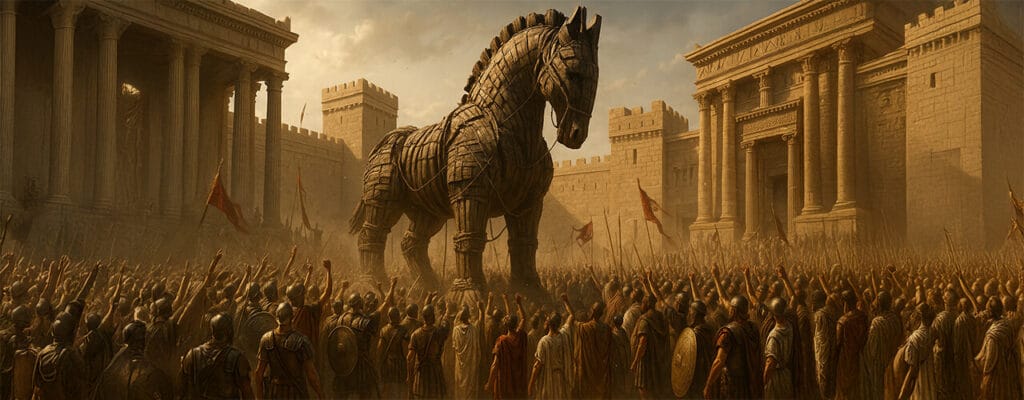
While the story of the Trojan Horse is likely symbolic, archaeological findings suggest that Troy was indeed violently destroyed. The destruction layer, dated to the 12th century BCE, shows signs of fire and conflict. Whether this destruction was caused by invading Greeks, other rival powers or natural disasters – it remains uncertain. Troy’s fall marked the end of its prominence, but its story survived, carried forward through myth and legend.
Troy is a part of our Turkey Private Tours. You can explore our Exclusive Turkey Tours here.
Troy’s Legacy: A Timeless Inspiration
Troy’s influence has lasted for thousands of years, serving as an inspiration for art, literature, and culture. Homer’s Iliad and Odyssey became the foundation of Western literature. The story of Troy also influenced Virgil’s Aeneid, which connects the fall of Troy to the founding of Rome.
In modern times, Troy’s tale has inspired many works of art. The 2004 Hollywood movie Troy brought the legend to a global audience, reimagining the epic for a new generation.
Today, the ruins of Troy stand as a UNESCO World Heritage Site, attracting visitors and researchers who try to uncover the truths hidden beneath the layers of myth and history.
Knowing the history is important, but being prepared for your trip is just as essential. Don’t miss our What to Wear in Turkey guide for clothing tips.
The rise and fall of Troy remain one of history’s greatest stories—a blend of reality and legend. From its origins as an important trade center to its tragic downfall, the story of Troy continues to fascinate humanity and will live on for generations to come.
